Humidity in your home: the complete guide to ending it
Ideal humidity level, wall mold, rising damp, and dehumidifiers: everything you need to know, backed by official sources.
20% of French homes suffer from excessive humidity (Qualitel 2025). Behind this figure hide very different realities: condensation on the windows of a Parisian apartment, saltpeter in the walls of a stone country house, a perpetually damp basement, or black mold silently invading bathroom joints. The problem is always the same — too much water — but the causes and solutions differ radically.
This guide is designed as the most complete resource in the French language on residential humidity. It covers the four topics that people search for the most: the ideal humidity level, solutions against mold, treating rising damp, and choosing an electric dehumidifier. Each section is based on verifiable official data.
20 %
damp French homes
Source: Qualitel 2025
30 %
households with major defect
Source: INSEE 2020
+15 %
energy consumption
Source: ADEME
×3
risk of child respiratory disease
Source: OMS
1. Ideal humidity level in a house: the ADEME reference
Hygrometry, or relative humidity, measures the proportion of water vapor in the air of a room, expressed as a percentage (%). It is the fundamental parameter to monitor in any home. Too low, the air becomes aggressive for mucous membranes and materials. Too high, it becomes an incubator for mold, dust mites, and respiratory pathologies.
✅ The ADEME golden rule: the ideal humidity level in a home is between 40% and 60%, for a temperature of 18 to 22 °C. Recommended range by ADEME, validated by the OMS and adopted by Qualitel.
Thresholds room by room
| Room | Target Level | Notes |
|---|---|---|
| Living Room / Lounge | 40 – 55 % | Main living area, ideally 45%. Protects furniture and parquet. |
| Adult bedroom | 40 – 50 % | Breathing releases 200-300 ml of water/night. VMC or daily ventilation is essential. |
| Baby bedroom | 45 – 55 % | Increased vigilance. Target: 50% at 19-20 °C for optimal and safe sleep. |
| Bathroom | ≤ 70 % (occasional) | Can rise to 70% during a shower, but must drop below 60% quickly. |
| Kitchen | 50 – 65 % | Cooking steam: hoods and VMC are essential. Avoid drying laundry in the kitchen. |
| Cave / Basement | ≤ 65 % | Critical area. Above 70%, dry rot can develop. |
Winter vs Summer: adapting your thresholds
In winter, heating dries out indoor air — hygrometry can drop below 35%, irritating respiratory tracts. Conversely, a poorly ventilated house in summer climbs to 70-80%, accelerating the development of mold.
- Winter (heating on): aim for 40-50%. A small humidifier can compensate if the air is too dry.
- Summer: tolerance up to 60%, beyond that a dehumidifier is necessary.
- Shoulder seasons: ventilate morning and evening for 10 minutes to renew the air.
How to measure at home?
A digital hygrometer (10 to 25 €) is sufficient in the vast majority of cases. Place it at breathing height (1.20-1.50 m), away from direct steam sources and heating vents. Note it at different times for a representative view. For a professional diagnosis, experts use precision hygro-thermal probes, infrared thermal camera, and pin-type moisture meters.
⚠️ Warning signs of high hygrometry: persistent fog on windows in the morning, moldy or musty smell, dark spots in corners, blistering paint, condensation on cold walls, feeling of cold despite the heating being on.
2. Wall mold: causes, dangers, and effective solutions
Molds are microscopic fungi that develop as soon as three conditions are met: an organic surface (plaster, paint, wood, wallpaper), a temperature between 5 and 35 °C, and a relative humidity above 70% for a prolonged period. Conditions frequently met in bathrooms, kitchens, basements, and poorly insulated exterior walls.
The 4 origins of mold
1. Condensation
Most frequent cause. Warm, humid air meets cold surfaces (windows, exterior walls, thermal bridges) and condenses.
Distinctive sign: Grey-black mold in corners, fog on windows, ceilings affected first.
2. Rising damp
Ground moisture rises into walls by capillarity. More common in old houses without a waterproof barrier.
Distinctive sign: Spots on the lower part of walls with white saltpeter, paint bubbling at the bottom of partitions.
3. Water infiltration
Rainwater penetration through roof, cracked facade, poorly sealed windows, or defective foundations.
Distinctive sign: Spots that appear or worsen after rain, often at the top of walls or on the ceiling.
4. Insufficient ventilation
A faulty VMC or blocked vents trap the humidity produced by occupants.
Distinctive sign: Generalized musty smell, simultaneous mold in several rooms.
Health dangers
Molds release spores and volatile organic compounds (VOCs). Prolonged exposure causes:
- Aggravation of asthma: spores are a major trigger for attacks.
- Allergic rhinitis and conjunctivitis: immune reactions to inhaled spores.
- Lung infections: dangerous for immunocompromised people, infants, and the elderly.
- Skin irritations: eczema, contact dermatitis.
- Chronic fatigue and sleep disorders: directly linked to indoor air quality.
🚨 Dry rot: the destructive fungus. Dry rot (Serpula lacrymans) digests wood cellulose. Orange to brown color, filamentous appearance. If you suspect it, call an expert immediately: reporting it is mandatory during a real estate sale.
5 solutions to eliminate mold
- Immediate cleaning (areas ≤ 1 m²): FFP2 mask, white vinegar 2/3 + water 1/3, let act 1 h, scrub and dry.
- Professional fungicide treatment: dichlorofluanid, hydrogen peroxide, or quaternary ammonium for larger areas.
- Improving ventilation: single-flow VMC (500-1,500 €) or double-flow VMC (3,000-8,000 €, eligible for MaPrimeRénov' up to 2,000 €).
- Microporous anti-humidity paint: as a supplement, never alone.
- Thermal insulation of cold walls: 50-150 €/m², eliminates thermal bridges.
💡 Absolute rule: cleaning mold without treating the humidity source is like emptying a leaky bucket. The fungi will inevitably return.
3. Rising damp: diagnosis, methods, and prices 2026
Water present in the ground infiltrates porous walls and rises through capillarity up to 1.50 meters in height, sometimes more. It carries with it mineral salts that form saltpeter and gradually weakens the masonry.
Recognizing rising damp
- Persistent humidity spots on the lower part (0 to 1.50 m from the floor)
- White or yellowish efflorescence (saltpeter)
- Paint blistering, swelling, or peeling at the bottom of partitions
- Damp earth smell on the ground floor or in the basement
- Problem present all year round, independent of seasons
- Gradual worsening if untreated
⚠️ Saltpeter vs mold: saltpeter is white/greyish, powdery, odorless, on the lower part. Mold is dark, smelly, at any height. Simple test: saltpeter is soluble in water but returns quickly.
The 5 treatment methods
| Method | Effectiveness | Price | Durability | Recommended for |
|---|---|---|---|---|
| Water-repellent resin injection | Very high | 40 – 200 € / ml | 10-30 years (guaranteed) | Solid walls, marked rising damp |
| Peripheral drainage | High | 200 – 500 € / ml | Permanent | Very humid ground, nearby water table |
| Tanking (waterproof coating) | Medium | 80 – 200 € / ml | Variable | Basements, earth-retaining walls (counter-pressure) |
| Electro-osmosis | Medium | 1,000 – 3,000 € (flat rate 15 ml) | Preventive, low rising damp | Low humidity, for prevention |
| Atmospheric siphons | Partial | 20 – 80 € / ml | Limited | Slight rising damp only |
Focus: water-repellent resin injection
Standard technique. Holes are drilled horizontally into the lower part of the wall (every 10 to 15 cm), then water-repellent resin is injected until saturation. Upon contact with moisture, the resin polymerizes and creates a waterproof chemical barrier.
- Duration: 1 to 2 days for a standard house
- Complete drying: 6 to 18 months depending on thickness
- Ten-year guarantee: required from any certified pro
- Precaution: no major cracks before injection
Total Budget 2026
The average budget observed for a complete treatment in France is 4,000 to 6,000 €, including diagnosis (300-800 €). Significant cost, but untreated rising damp can devalue a property by up to 20% and block obtaining a favorable DPE.
📋 Checklist before choosing a professional: Qualibat certified (specialty 6112), verifiable ten-year insurance, preliminary diagnosis, detailed technical quote, similar site references, VAT reduced to 10% (housing > 2 years).
4. Electric dehumidifier comparison 2026
An electric dehumidifier sucks in ambient air, passes it over cold coils that condense the water vapor, and releases dried air. The collected water flows into a tank or towards a continuous drain.
The two main technologies
Compressor
- Most effective (12 to 30 L/day)
- Surfaces 30-150 m²
- Effective from 15 °C
- 40-55 dB, 150-600 €
- Class A+ to A+++
Thermoelectric (Peltier)
- 250-700 ml/day
- Small spaces ≤ 20 m²
- Silent (25-35 dB)
- Compact, 40-150 €
- Less effective at low T°
Capacity to choose according to surface area
| Surface area to treat | Recommended capacity | Recommended technology |
|---|---|---|
| Small room ≤ 20 m² | 10-12 L/day | Peltier or compact compressor |
| Living area 20-50 m² | 16-20 L/day | Compressor |
| Entire house 50-120 m² | 20-30 L/day | Powerful compressor |
| Cave / Basement | 20-30 L/day + low temperature | Special basement compressor |
Essential criteria
- Integrated humidistat: essential, the device stops at the target (e.g. 50%).
- Energy class: A+++ saves up to 30% vs A+ over the year.
- Noise level: < 40 dB for use in a living area, essential in a bedroom.
- Real capacity: divide the manufacturer capacity by 2 or 3 (standardized conditions 30 °C / 80%).
Our 2026 Selection
🥇 Best quality/price ratio
Comfee 20 L
Accurate humidistat, 5 L tank, 42 dB. Ideal for 50-80 m². Class A+.
🥈 Best for heavy duty use
Inventor EVA II Pro 20 L
Effective from 5 °C, auto-defrost, excellent for basements. Class A++.
🥉 Best compact for apartments
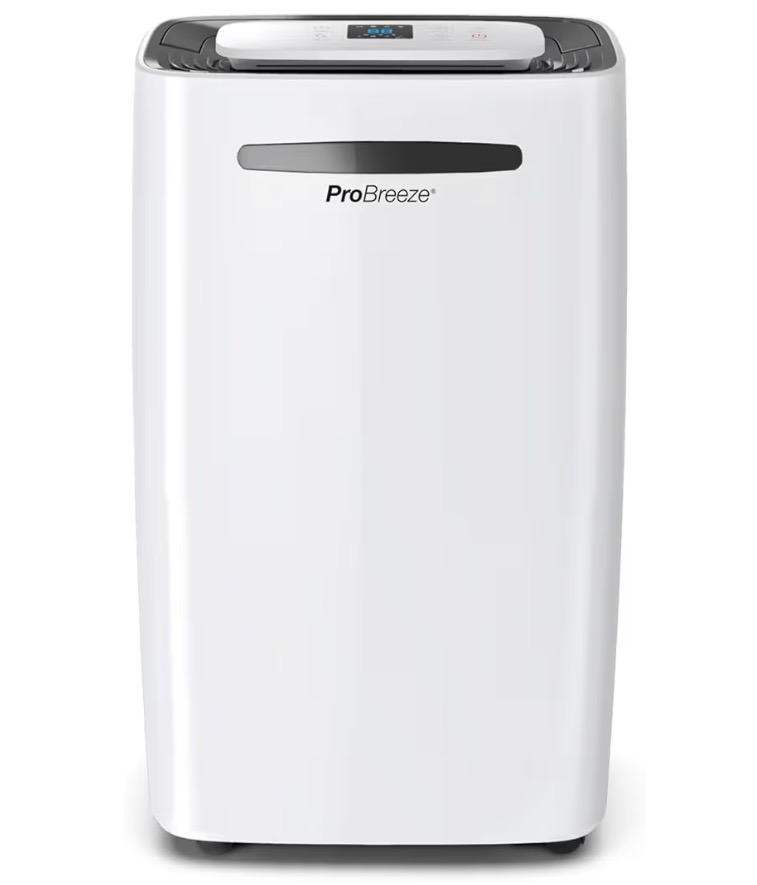
Pro Breeze 12 L
38 dB, 2.5 L tank, perfect for bedroom/dressing/20-40 m². < 100 €.
👉 See our detailed comparison of the best basement dehumidifiers 2026.
5. Treating humidity step by step
- Measure and document: hygrometer (10-25 €), morning and evening readings for a week, photos of affected areas.
- Identify the type of humidity: condensation, rising damp, leaks, or insufficient ventilation. Each type calls for a different solution.
- Immediately improve ventilation: 10 min × 2/day aeration, VMC control, kitchen hood, no laundry in the bedroom. Gain of 10-15 points possible.
- Call a certified expert for a structural diagnosis: Qualibat, diagnosis 300-800 € (often deducted from the quote).
- Carry out structural work: resin injection, roofing, VMC, tanking according to diagnosis.
- Deploy a dehumidifier in addition: comfort and maintenance tool, never a unique solution.
- Treat surfaces and prevent return: fungicide, anti-humidity paint, annual check-up before autumn.
A persistent humidity problem?
Our Qualibat/RGE certified experts operate throughout France. Free diagnosis, quote within 48 h.
Find an expert near meFrequently Asked Questions
What is the ideal humidity level in a house?
The ideal humidity level in a home is between 40% and 60%, according to ADEME recommendations. In winter, aim for 40-50% to avoid condensation. In summer, 50-60% remains comfortable. Below 40%, the air is too dry and irritates mucous membranes. Above 60%, mold and dust mites actively proliferate.
How to eliminate mold on walls?
For small areas, a solution of white vinegar (2/3) and water (1/3), sprayed and left for 1 hour, is often sufficient. For larger areas, use a professional fungicide. But beware: cleaning without treating the cause of humidity guarantees the return of mold. Condensation, rising damp, or ventilation defects must be corrected in parallel.
How much does a rising damp treatment cost?
Water-repellent resin injection, the most effective method, costs between 40 and 200 €/ml. For a house with 40 linear meters of treated walls, the total budget is around 4,000 to 6,000 €, including diagnosis. An untreated problem can devalue the property by up to 20% of its value.
Which dehumidifier to choose for an 80 m² house?
For an 80 m² house with moderate humidity, a 20 L/day compressor dehumidifier with an integrated humidistat is recommended. Aim for a minimum energy class A+. The Comfee 20 L model offers the best quality/price ratio in this category in 2026.
Can rising damp return after treatment?
A properly executed resin injection treatment is considered definitive, with a guarantee of 10 to 30 years. Recurrence after injection signals either incorrect application (holes too far apart, low-quality resin) or an unidentified secondary cause (cracks in foundations, insufficient drainage). Hence the importance of working with a Qualibat certified professional.
What is the difference between humidity and condensation?
Humidity refers to the presence of water vapor in the air (measured by the hygrometer). Condensation is a physical phenomenon: when warm, humid air meets a cold surface, the vapor turns into liquid water. Condensation is therefore a consequence of excessive humidity, not a standalone cause.
Can a tenant demand anti-humidity work?
Yes. According to the law of July 6, 1989, and the decree of January 30, 2002, a decent home must not present risks to the health of the occupants. Excessive humidity, persistent mold, and rising damp constitute decency defects. The tenant can serve the landlord with a formal notice by registered letter, then contact the departmental conciliation commission.
Does humidity lower the value of a property?
Yes, significantly. A home showing signs of humidity, mold, or rising damp can lose 10 to 20% of its value compared to an equivalent healthy property. Mandatory diagnostics (dry rot, parasitic state) during a sale can also block the transaction.
Rédaction ZeroHumi
ZeroHumi editorial team
Technical documentation verified against the cited sources (ADEME, ANSES, WHO, CSTB, CEREMA)
Sources and references
This article relies on official, verified sources to guarantee reliable information.
- [1]
- [2]
- [3]Housing quality observatory, 2025 report— Qualitel
- [4]
- [5]Impact of humidity and mold on respiratory health— Santé Publique France
- [6]
- [7]Energy renovation subsidies (VMC, insulation)— MaPrimeRénov'