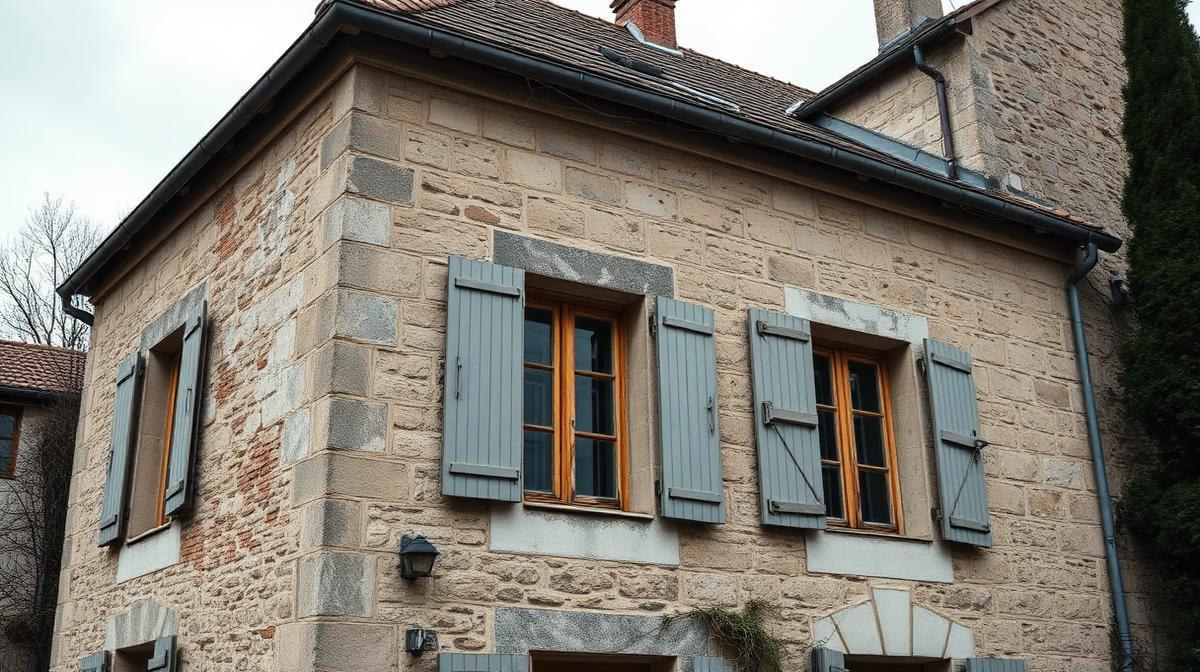
Old house humidity: diagnostic, causes and complete solutions
11 million French homes built before 1948 are exposed to humidity problems. Rising damp, unsuitable plasters, lack of ventilation: this guide identifies each pathology and details the technical solutions validated by CSTB and Cerema.
11M
homes before 1948
37%
affected by humidity
2 200 €
average treatment cost
15-30%
real estate value loss
Why are old houses vulnerable?
According to INSEE, 11 million French homes were built before 1948. These buildings use porous materials — limestone, solid brick, cob, rammed earth — which function on a fundamental principle: breathability.
A breathable wall absorbs moisture from the ground and air, moves it through its thickness, then releases it by evaporation on the exterior side. This natural mechanism, described in DTU 20.1 by CSTB, effectively regulates indoor humidity — provided it is not disrupted by modern watertight materials.
💡 Key point: An old stone house is not "poorly built". It functions differently from a modern construction. Humidity problems occur when solutions designed for concrete are applied to it.
The 5 main causes of humidity in old houses
1. Rising damp
Groundwater rises into the walls through capillary action via porous materials. In the absence of a waterproof barrier (non-existent in pre-1960 constructions), water can rise up to 1.50 m in height.
Signs: Stains at the bottom of the wall, saltpetre, plaster peeling at ground level, musty smell at the foot of the wall.
Source: Cerema — Guide for the rehabilitation of old buildings
2. Condensation and ventilation failure
Old houses were designed with natural ventilation (chimneys, high and low vents). Installing airtight double-glazed windows without VMC creates confinement that traps water vapor.
Signs: Fogging on windows, mold in room corners, uniform humidity throughout the home.
Source: OQAI — Indoor air quality measurement campaign in homes
3. Lateral infiltration and roof leaks
Buried walls (cellars, basements) without drainage receive hydrostatic pressure from the ground. Old roofs (slate, canal tile) can also have sealing defects.
Signs: Stains that appear or worsen after rain, visible runoff, puddles in the cellar.
Source: DTU 20.1 — CSTB
4. Unsuitable plasters and coatings
Applying cement plaster, waterproof paint, or non-breathable interior insulation blocks the wall's natural evaporation. Moisture accumulates at the interface and degrades the structure.
Signs: Blisters and peeling under the plaster, white efflorescence, mapped cracking.
Source: Cerema — Rehabilitation recommendations
5. Leaking underground networks
Old pipes (lead, cast iron) can leak for years without being detected, saturating the soil around the foundations and feeding rising damp.
Signs: Unexplained increase in water bill, localized damp area unrelated to rain.
Source: CSTB — Building pathologies
How to diagnose the problem
A reliable diagnostic relies on objective measurements, not intuition. Here are the tools and methods used by certified professionals:
| Method | What it measures | Accuracy | Indicative cost |
|---|---|---|---|
| Ambient hygrometer | Relative air humidity level | ±3% | 15-50 € |
| Contact moisture meter | Superficial wall moisture | ±2% | 30-100 € |
| Carbide bomb test | Deep weight humidity of the material | ±0.5% | 300-500 € (pro) |
| Thermal camera | Cold zones = thermal bridges + humidity | Visual | 400-800 € (pro) |
| Salt analysis | Type of salts (nitrates, sulfates, chlorides) | Lab | 150-300 € (lab) |
⚠️ Important: A simple hand test ("the wall feels cold to the touch") does not allow distinguishing between condensation, rising damp, and infiltration. Only an instrumented diagnostic identifies the real source.
The 3 renovation mistakes that make humidity worse
Mistake #1: Coating a stone wall with cement
❌ The problem
Cement plaster has a Sd value (water vapor diffusion resistance) of 2 to 10 m, compared to 0.1 to 0.3 m for lime plaster. It completely blocks the wall's breathability.
✅ The solution
Chiselling off the cement plaster and replacing it with natural hydraulic lime plaster (NHL 3.5). Expect 40 to 80 €/m² supplied and installed.
Mistake #2: Insulating from the inside with polystyrene
❌ The problem
Polystyrene (EPS, XPS) is impermeable to water vapor. Placed against a damp wall, it creates a "dead zone" where condensation accumulates and mold proliferates.
✅ The solution
Prioritize breathable insulators: wood fiber (λ = 0.038), cork (λ = 0.040), lime-hemp plaster (λ = 0.070). Exterior insulation is preferable if local planning rules allow.
Mistake #3: Installing airtight windows without ventilation
❌ The problem
Old windows (single-glazed wood) provided passive ventilation through lack of airtightness. Replacing them with PVC double-glazing without installing VMC removes all air circulation.
✅ The solution
Install a type B humidity-controlled VMC (2,500-4,000 €) or at least humidity-controlled air inlets on new windows.
Technical solutions adapted to old buildings
Hydrophobic resin injection
Perimeter drainage
Lime plaster
Type B humidity-controlled VMC
Interior tanking (Cuvelage)
Prices and financial aid 2026
| Intervention | Average price | Possible aid |
|---|---|---|
| Professional diagnostic | 300-800 € | Sometimes free via ADIL |
| Rising damp injection (100m² house) | 3,000-6,000 € | MaPrimeRénov' (conditions apply) |
| Complete perimeter drainage | 8,000-15,000 € | Eco-PTZ up to 50,000 € |
| Interior lime plaster (50m²) | 2,000-4,000 € | Fondation du Patrimoine (listed building) |
| Type B humidity-controlled VMC | 2,500-4,000 € | MaPrimeRénov' + CEE |
| Cellar tanking (30m²) | 3,000-6,000 € | No specific aid |
💰 Good to know: ANAH offers reinforced aid for the renovation of old housing ("Habiter Mieux" program). Owner-occupiers with modest incomes can obtain up to 50% coverage for humidity-related work.
Frequently Asked Questions
How do I know if my old house has a humidity problem?
Telling signs are: dark spots or rings on walls (especially at the bottom), saltpetre (white crystalline deposits), a persistent musty smell, blistering or peeling paint, and a humidity level above 65% measured with a hygrometer. In stone houses, check particularly buried walls and floor-wall joints.
Why are old houses more prone to humidity?
Houses built before 1948 use porous materials (stone, solid brick, cob) without a waterproof barrier in the foundation. They function on a "breathable wall" principle that naturally regulates humidity. But unsuitable renovations (cement plaster, airtight interior insulation) block this mechanism and trap moisture within the walls.
What is the average cost to treat humidity in an old house?
Costs vary according to the pathology: injection against rising damp (80-150 €/ml), perimeter drainage (150-300 €/ml), lime plaster (40-80 €/m²), humidity-controlled VMC (2,000-4,000 €). A professional diagnostic costs between 300 and 800 €. Aid exists via MaPrimeRénov' and ANAH for old housing.
Can you insulate a damp old house from the inside?
Interior insulation of a damp wall is risky: it can worsen the problem by preventing evaporation. The source of humidity must be treated first, then breathable materials (wood fiber, cork, lime-hemp) should be used to allow water vapor to migrate. According to the CSTB, exterior insulation is preferable when heritage constraints allow it.
Is cement plaster bad for an old house?
Yes, it is one of the most common mistakes. Cement plaster is impermeable to water vapor: it prevents the wall from "breathing" and traps moisture inside. For old stone or brick buildings, a lime-based plaster (aerial or natural hydraulic NHL 3.5) must be used to allow the wall's natural hygral exchanges.
Is your old house suffering from humidity?
Find a certified specialist in old buildings near you.
Find an expertRédaction ZeroHumi
ZeroHumi editorial team
Technical documentation verified against the cited sources (ADEME, ANSES, WHO, CSTB, CEREMA)
Sources and references
This article relies on official, verified sources to guarantee reliable information.
- [1]National housing survey 2024— INSEE
- [2]
- [3]
- [4]
- [5]
- [6]
- [7]Humidity and respiratory health— Santé Publique France