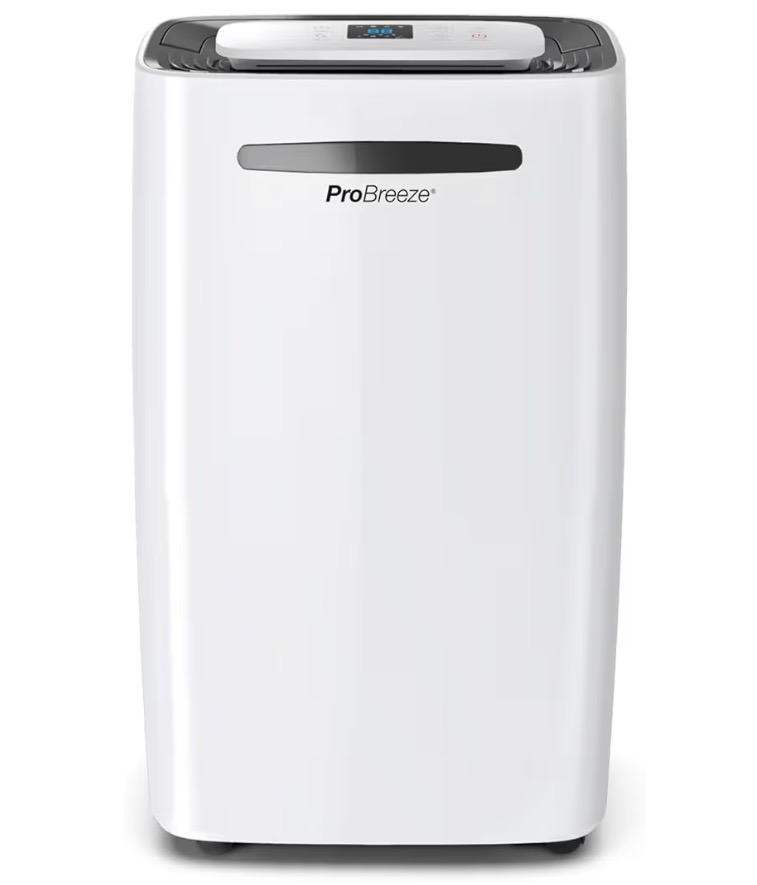
Moisture Absorber: Is It Really Effective?
Short answer: Yes, but only for small enclosed spaces. For a living room or a significant moisture problem, a chemical absorber is not enough.
How Does an Absorber Work?
A moisture absorber contains calcium chloride crystals orlithium salt that attract and capture moisture from the air. The absorbed water drains into a collection tank that you empty regularly.
A standard absorber can capture between 100 and 500 ml of water per month, which is sufficient for a closet or a small enclosed room, but negligible for a bedroom or a living room. Calcium chloride absorbs up to 300% of its weight in water, compared to only 0.5% for table salt.
Absorber vs Dehumidifier: Data Comparison
| Criterion | Chemical absorber | Electric dehumidifier | Ratio |
|---|---|---|---|
| Capacity/month | 100-500 ml | 300-900 L | x600 |
| Effective area | < 20 m² | 30-100 m² | x5 |
| Purchase cost | 5-15 € | 150-400 € | x20 |
| Cost/year (heavy use) | 80-150 € (refills) | 100-200 € (electricity) | ~equal |
| Noise | 0 dB | 35-50 dB | Silent vs audible |
| Consumption | 0 W | 200-500 W | Zero vs ~15€/month |
Sources: UFC-Que Choisir, ADEME, ZeroHumi tests
Pros and Cons
Points forts
- No electricity consumption
- Totally silent
- Very low purchase price (5-15 €)
- Compact and discreet
- Simple to use
Points faibles
- Very limited capacity (100-500 ml/month)
- Effective only for small spaces (< 20m²)
- Refills must be purchased regularly (80-150€/year)
- Does not regulate humidity levels
- Ineffective against structural moisture
When Is the Absorber Effective?
Suitable uses
- • Closets and wardrobes
- • Storage chests
- • Wine cellars (small volumes)
- • Caravans and motorhomes
- • Boats (cabins)
- • Enclosed garages (small)
Unsuitable uses
- • Bedrooms and living rooms
- • Bathrooms
- • Basements and underground cellars
- • Infiltration problems
- • Rising damp
- • Recurring mold
More Effective Alternatives
Electric dehumidifier
Extracts 10 to 30 liters of water per day. Ideal for living areas and moderate moisture problems.
Absorber vs dehumidifier comparison →VMC or VMI
Mechanical ventilation is the most durable solution against condensation moisture.
VMC vs VMI: which solution to choose →Source treatment
If moisture comes from infiltration or rising damp, only a professional treatment will solve the problem.
Complete moisture treatment guide →Real Test: Absorber in a Closet
Comparative test - 2m³ Closet, Normandy
Musty smelling clothes, 78% humidity in bedroom closet
3 absorbers tested over 8 weeks: Rubson, Seko, store brand
Rubson: 420ml recovered • Seko: 380ml • Store brand: 290ml
Rubson: 8€ + refills 12€ • Seko: 6€ + refills 10€ • Store brand: 4€ + refills 6€
Effective for this closet. But adjacent room (15m²): no measurable effect
Absorber = targeted solution, not a global solution
Our Verdict
The moisture absorber is an effective supplementary tool for small enclosed spaces (closets, chests, caravans). But it cannot replace proper ventilation nor treat a structural moisture problem. Actual annual cost: 80-150€ in refills, which is as much as an electric dehumidifier in electricity, but 60x less effective.
Sources and references
This article relies on official, verified sources to guarantee reliable information.
- [1]Moisture absorber test - 2024 Comparison— UFC-Que Choisir
- [2]Indoor air quality guide— ADEME
- [3]
- [4]Absorber market in France— Xerfi
Rédaction ZeroHumi
ZeroHumi editorial team
Technical documentation verified against the cited sources (ADEME, ANSES, WHO, CSTB, CEREMA)