Humidity and Real Estate Value:How Much Are You Really Losing in 2026?
Resale discount, degraded DPE, rental ban, hidden defects: humidity doesn't just attack your walls, it erodes your assets. Documented analysis based on data from Notaires de France, ADEME, INSEE and Légifrance.
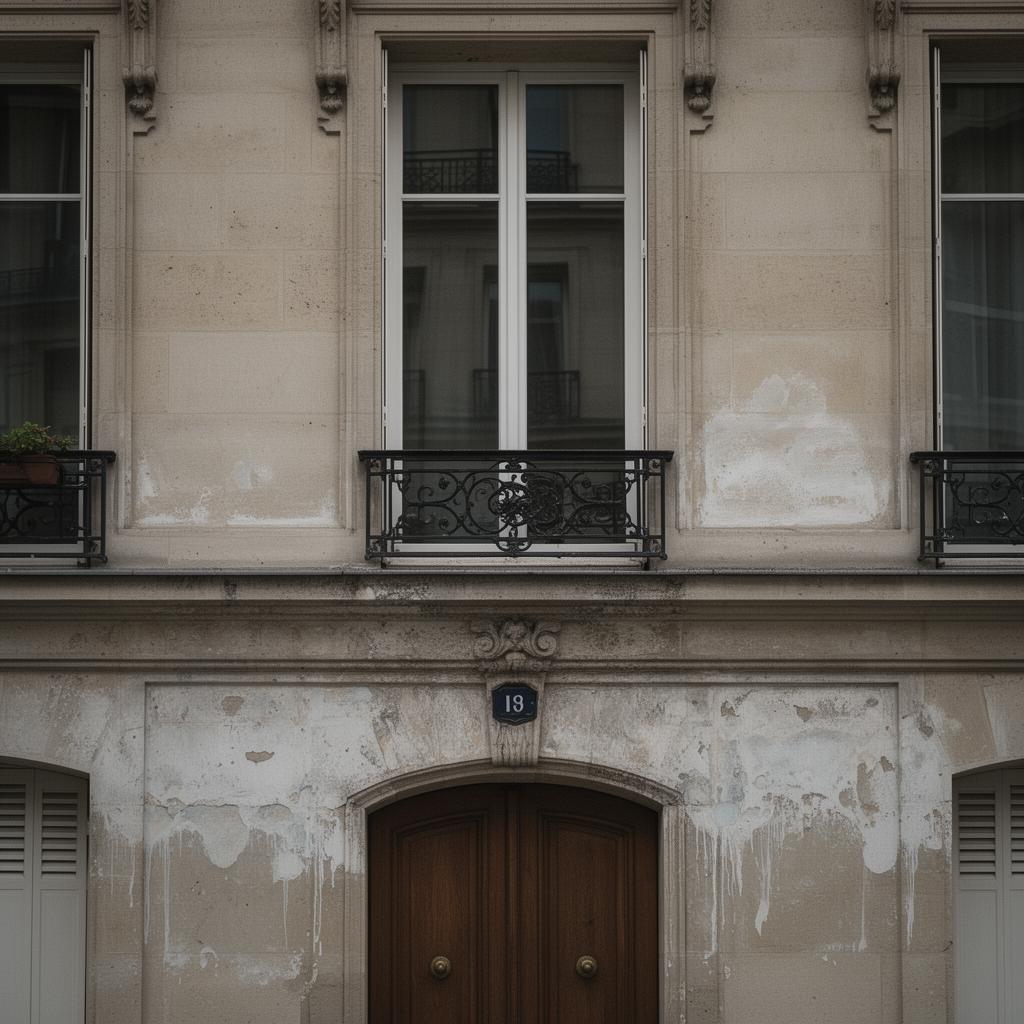
Sources of the above figures: Qualitel barometer on housing quality, law n° 2021-1104 of August 22, 2021 (art. 160), ADEME (DPE sheet), French Civil Code. All links at the end of the article.
1. Quick Answer: What Humidity Costs You
In summary: in France in 2026, a property affected by a proven humidity problem suffers three cumulative penalties: (1) a negotiation discount corresponding to the estimated cost of works (averaging €3,000 to €30,000), (2) a DPE downgrade that can push the property into F or G (prohibited from rental according to the Climate & Resilience law schedule), and (3) a 2-year legal risk under the warranty of hidden defects (article 1641 of the Civil Code) if the defect is not declared.
Contrary to popular belief, it's not so much the nominal value of the property that drops as a combination of mechanisms that make the transaction more difficult: fewer interested buyers, harder negotiations, more complex bank financing (banks now look at the DPE), and a mandatory energy audit for classes F and G since April 1, 2023 (source: Ministry of Ecological Transition).
2. 2026 Legal Framework: The Law Tightens Valuation
Since 2021, the French legislature has methodically reconnected housing energy performance (where humidity plays a major role) to its economic value. Here are the laws that apply to your property:
| Text | Effective Date | Consequence |
|---|---|---|
| Climate & Resilience Law (n° 2021-1104, art. 160) | Jan 1st, 2025 | DPE Class G housing prohibited from rental (new leases) |
| Climate & Resilience Law | Jan 1st, 2028 | DPE Class F housing prohibited from rental |
| Climate & Resilience Law | Jan 1st, 2034 | DPE Class E housing prohibited from rental |
| Energy Audit mandatory (art. L.126-28-1 CCH) | Apr 1st, 2023 | Sale of a class F or G single-family home |
| "Decency" Decree n° 2002-120 (art. 2) | In force | Housing protected against infiltration and humidity (or tenant recourse) |
| Article 1641 of the Civil Code – hidden defects | In force | Buyer action within 2 years of discovering the defect |
Text
Climate & Resilience Law (n° 2021-1104, art. 160)
Effective Date
Jan 1st, 2025
Consequence
DPE Class G housing prohibited from rental (new leases)
Text
Climate & Resilience Law
Effective Date
Jan 1st, 2028
Consequence
DPE Class F housing prohibited from rental
Text
Climate & Resilience Law
Effective Date
Jan 1st, 2034
Consequence
DPE Class E housing prohibited from rental
Text
Energy Audit mandatory (art. L.126-28-1 CCH)
Effective Date
Apr 1st, 2023
Consequence
Sale of a single-family home classified F or G
Text
“Decency” Decree n° 2002-120 (art. 2)
Effective Date
In force
Consequence
Housing protected against infiltration and humidity (or tenant recourse)
Text
Article 1641 of the Civil Code – hidden defects
Effective Date
In force
Consequence
Buyer action within 2 years of discovering the defect
Source: Légifrance (consolidated texts as of January 1, 2026), Service-Public.fr, Ministry of Ecological Transition.
3. DPE: Why Humidity Degrades Your Energy Class
The Energy Performance Diagnosis is based on primary energy consumption and greenhouse gas emissions. Humidity acts indirectly but massively on these two indicators.
According to ADEME, a damp wall sees its thermal resistance drop. The thermal conductivity of water (0.6 W/m·K) is about 25 times higher than that of dry air trapped in the pores of a construction material. In practice, a wall saturated with water loses a significant part of its insulating power — a magnitude often cited by ADEME is up to 25% less insulation capacity.
Mechanism: why a damp wall consumes more
- • Water replaces air in the pores → thermal conductivity multiplied.
- • Heat loss increases → the boiler runs longer.
- • Consumption kWh/m²/year rises → the DPE grade drops (D → E → F).
- • Moving to F or G triggers: mandatory audit at sale, rental ban eventually.
Source: ADEME – DPE educational sheet and impact of humidity defects on the envelope.
Asset consequence: treating infiltration or rising damp before a new DPE can gain one or two energy classes, which secures rental and increases perceived value at resale.
4. Hidden Defect: 2 Years to Sue You
Article 1641 of the Civil Code states that "the seller is bound by a warranty for hidden defects in the item sold which render it unfit for the use for which it was intended, or which diminish this use so much that the buyer would not have acquired it, or would only have given a lower price, if he had known them."
In matters of humidity, case law regularly classifies as hidden defects:undeclared rising damp, chronic infiltration hidden by new paint, the presence of dry rot concealed and significant mold behind furniture or wall coverings.
Buyer's action period
Action under the hidden defects warranty must be brought within 2 years of the discovery of the defect (article 1648 of the Civil Code). The buyer can request: (1) rescission of the sale with refund of the price, or (2) a price reduction proportional to the defect.
Special case of dry rot: in areas delimited by prefectural decree, article L.133-8 of the Construction and Housing Code requires the seller to inform the buyer of known dry rot presence. Failure to provide info engages their liability.
5. Sale Discount: How It Is Actually Calculated
There is no official scale published by the Notaires de France for the "humidity" discount. In practice, negotiation is built on three concrete bases:
Restoration estimates
The buyer requests at least one priced quote (or an expert report) and negotiates this amount directly off the price. This is the most used method.
Cost of energy audit and DPE works
For classes F and G, the mandatory audit (averaging €500 to €1,000) and the recommended work are anticipated by the buyer in their offer.
Psychological safety margin
Beyond the strict costing of the work, buyers often apply an additional margin (often 5% to 10%) to cover real uncertainty about the extent of the problem.
Methodology: observation of negotiation practices reported by real estate agents and legal professionals (public sources – ANIL, regional chambers of notaries). There is no single official percentage: each case is negotiated individually.
6. Simulation: 3 Concrete Priced Cases
The examples below combine the treatment price ranges published on ZeroHumi (verifiable via our comparisons and quotes) and the negotiation mechanism described above. The values are illustrative orders of magnitude, to be adjusted according to your local market.
| Case | Problem | Estimated work cost | Negotiation impact |
|---|---|---|---|
| Village house, 100 m² | Rising damp over 20 linear meters | €3,000 – €5,000 | Buyer deducts the quote; real DPE impact after work |
| Ground floor apartment, 60 m² | Condensation + missing VMC | €800 – €2,500 | Moderate discount but DPE rating often downgraded |
| Old house with basement | Tanking + peripheral drainage | €10,000 – €30,000 | Significant discount or condition precedent to carry out work |
Case
Village house, 100 m²
Problem
Rising damp over 20 lm
Estimated work cost
€3,000 – €5,000
Negotiation impact
Buyer deducts the quote; real DPE impact after work
Case
Ground floor apartment, 60 m²
Problem
Condensation + missing VMC
Estimated work cost
€800 – €2,500
Negotiation impact
Moderate discount but DPE rating often downgraded
Case
Old house with basement
Problem
Tanking + peripheral drainage
Estimated work cost
€10,000 – €30,000
Negotiation impact
Significant discount or condition precedent to carry out work
Source of price ranges: 2025-2026 national averages published by ZeroHumi from field quotes (see the article dedicated to costs). The negotiation practices cited are indicative.
7. 5-Step Action Plan (Seller & Landlord)
- 1
Get diagnosed
Contact an independent humidity expert (ideally Qualibat 1542 certified). The written report (€150 to €400) is enforceable and structures what comes next.
- 2
Update the DPE
The DPE is valid for 10 years. For classes F and G, the regulatory energy audit is required at the sale of a single-family home (since April 1, 2023).
- 3
Cost and prioritize the works
At least 3 quotes. Prioritize: ventilation, source treatment (injection, drainage, tanking), then aesthetic restoration.
- 4
Document and declare
Keep invoices, ten-year warranties, and formal completion reports. Attach these documents to the sales agreement: transparency neutralizes the risk of hidden defects.
- 5
Value in the listing
Explicitly mention the sanitation work carried out, new VMC, updated energy audit. These elements reassure banks and buyers.
8. FAQ – Frequently Asked Questions
Does humidity lower the value of a property?
Yes. Humidity degrades the value of a home in several cumulative ways: visible damage (stains, saltpeter, mold) that deters buyers, extra energy costs penalizing the DPE (a damp wall can lose up to 25% of insulating power according to ADEME), declarable health risks, and the cost of repairs to be deducted from the price during negotiation. When humidity is proven, buyers typically negotiate the estimated cost of repairs (often €5,000 to €30,000) directly off the sale price.
Must humidity be declared when selling a property?
Yes, it is a legal obligation. Article 1641 of the Civil Code imposes the warranty against hidden defects on the seller. Hiding a known humidity problem (rising damp, chronic infiltration, dry rot) exposes the seller to legal action: the buyer can request the cancellation of the sale or a price reduction within 2 years of discovering the defect. Dry rot is subject to a specific declaration obligation in risk areas (article L.133-8 of the Construction and Housing Code).
Can a damp home be prohibited from rental?
Yes. Since the Climate & Resilience law of August 22, 2021, homes classified as G in the DPE have been banned from rental since January 1, 2025, F will be on January 1, 2028, and E on January 1, 2034. However, humidity significantly degrades energy performance (a damp wall insulates up to 25% less well according to ADEME). Furthermore, the "decency" decree requires housing to be protected against parasitic air infiltration and humidity (article 2 of decree n° 2002-120). A tenant can refer the matter to the conciliation commission or the judge to demand repairs.
How much does humidity treatment cost before a sale?
The average price ranges in France for 2026 are: professional humidity diagnosis (€150 to €400), resin injection against rising damp (€80 to €150 per linear meter), peripheral drainage (€150 to €250 per linear meter), basement tanking (€200 to €500 per m²), installation of a single-flow VMC (€800 to €1,500), mold treatment (€500 to €2,000). For a 100 m² house with rising damp over 20 linear meters, expect an average of €3,000 to €5,000. These works are paid off by the increased value of the property (often 2 to 5 times the cost invested).
Can a buyer withdraw because of humidity?
Yes, in several cases. (1) During the 10-day cooling-off period after signing the sales agreement (article L.271-1 of the Construction Code). (2) If the humidity constitutes an undeclared hidden defect (article 1641 of the Civil Code): action possible up to 2 years after discovery. (3) If a condition precedent (additional diagnosis, expertise) is included in the compromise. The presence of dry rot, in a risk zone declared by prefectural decree, must be revealed and can justify the cancellation of the sale.
Preserve the value of your property
Get a free humidity diagnosis and a priced quote from an expert near you. No obligation.
Further reading
Sources and references
This article relies on official, verified sources to guarantee reliable information.
- [1]
- [2]Housing decency: the energy performance criterion (DPE G, F, E)— Service-Public.fr
- [3]
- [4]Notaires de France – Real estate market report (quarterly publications)— Notaires de France
- [5]
- [6]
- [7]
- [8]
- [9]MTECT – Regulatory energy audit for sales of class F and G housing— Ministère de la Transition Écologique
Rédaction ZeroHumi
ZeroHumi editorial team
Technical documentation verified against the cited sources (ADEME, ANSES, WHO, CSTB, CEREMA)