Short answer: heating warms the air, it doesn't remove the water it contains. Until the humidity produced (showers, cooking, laundry, breathing) is evacuated by ventilation or captured by a dehumidifier, it condenses on cold surfaces — and feeds mold.
Heating doesn't dry the air, it warms it
This is the most common logical error in winter: people think a radiator "dries out" a room. In reality, an auxiliary heater warms the air, it doesn't remove the water it contains. Confusing the two is exactly what drives thousands of households to allow mold to develop even when they are heating normally.
To understand why, we need to talk about the dew point. Warm air can hold much more water vapor than cold air. When you heat a room, its relative humidity mechanically drops, even if the actual amount of water hasn't moved a gram. As soon as this warm air encounters a cold surface — single glazing, poorly insulated wall, poorly heated corner — the vapor returns to a liquid state: that's condensation, the number one breeding ground for mold.
Order of magnitude: at 20 °C and 50% relative humidity, the dew point is around 9-10 °C. Any surface dropping below this temperature becomes an active condensation point, even if the rest of the room appears dry. This is why mold almost always concentrates in the same place.
It's not just a matter of comfort. In its indoor air quality guidelines, the World Health Organization associates prolonged exposure to dampness and household mold with an increase in respiratory symptoms, allergies, and asthma, with a particularly marked risk for children and the elderly. See also our feature on humidity and health.
The 7 mistakes that promote mold in winter
1. Heating without ventilating
This is the most common and most damaging mistake. To save energy, many households close windows, VMC, and air vents as soon as the heating is on, to "not lose heat." Result: the humidity produced every day no longer has a way out. It stays trapped in the home and ends up condensing on the coldest surfaces.
To give an idea of scale, the National Housing Agency (Anah) estimates that the mere breathing of a family of two adults and two children releases about 6 kg of water vapor per day, to which are added showers, cooking, and household activities — about 2.3 tons of water per year to be evacuated by ventilation.
Best practice: Ventilate for 5 to 10 minutes a day, even in the middle of winter, ideally with a wide draft rather than a window left slightly open continuously. If you have a VMC, never turn it off. The best time: right after a shower, cooking, or drying laundry.
2. Choosing a heater that doesn't manage humidity
A classic electric heater (convector, radiant, radiant panel) warms the air without affecting the amount of water it contains. In an already humid room (basement, laundry room, poorly ventilated bedroom), this temporarily masks the problem without ever fixing it: the water stays in the air and re-condenses as soon as the room cools down at night.
A heater that constantly turns off and restarts (poorly calibrated or missing thermostat) creates precisely the temperature differences responsible for nightly condensation. A precise, or even programmable, thermostat is therefore a real anti-humidity criterion — not just a cost-saving argument.
Best practice: Prioritize a model with fine regulation (ceramic with precise thermostat, regulated fan heater) capable of maintaining a stable temperature day and night.
3. Drying laundry or using a drying rack in a heated room
Drying clothes on a rack in the living room or bedroom in winter is one of the most underestimated sources of humidity. Drying takes place over several hours, during which the vapor spreads throughout the room — and condenses on cold spots.
Best practice: Dry laundry in a ventilated room (laundry room, insulated garage), or close the door of the room concerned and place a dehumidifier there while drying: it's much faster and the humidity doesn't spread through the home.
4. Ignoring thermal bridges
A thermal bridge is a point where insulation is interrupted: wall corner, window frame, floor/wall junction, concrete lintel. These areas remain significantly colder than the rest of the room, even with the heating on full blast. This is why mold almost always appears in the same place.
A sign that doesn't lie: if a corner of the ceiling or wall is systematically colder to the touch in winter, it's very likely a thermal bridge.
Best practice: Heating harder never solves a thermal bridge. The real solution is structural (additional insulation); in the meantime, monitor these areas with a hygrometer and direct ventilation toward them.
5. Overheating to "dry out" a damp room
Heating harder does not remove water from the air: it only increases its capacity to hold more, until it encounters a cold surface and releases it as condensation. In a cellar or basement, the effect is even more pronounced because of the gap with buried walls.
The mistake is frequent after water damage: "cranking the heating up for a few days" gives an impression of a result that reverses as soon as the temperature returns to normal, because the water never left the home.
Best practice: Combine moderate heating and active dehumidification: this is the only combination that actually removes water from the air.
6. Forgetting the hygrometer
You only manage well what you measure. Above 60% relative humidity continuously, the risk of mold increases sharply; the ideal is between 40 and 55% depending on the room. The EPA recommends staying below 60%, with an ideal range of 30 to 50%.
Ideally, one hygrometer per high-risk room (poorly ventilated bedroom, bathroom, basement, laundry room) rather than a single central device: relative humidity varies significantly from one room to another.
Best practice: A hygrometer costing a few euros allows you to know when to ventilate or trigger a dehumidifier, instead of acting when black spots are already visible.
7. Using an undersized dehumidifier
A device designed for 20 m² placed in a very damp 40 m² basement will run continuously without ever reaching the target rate: premature wear and a false sense of security.
Another neglected point: a poorly maintained dehumidifier (clogged filter, reservoir never emptied on time) quickly loses efficiency, which looks like undersizing when it's actually about maintenance.
Best practice: Size based on real surface area, starting rate, and active sources of humidity. A 20 L/day unit is suitable for a standard 40 m² room; a very damp cellar requires more, or continuous operation with direct drainage.
Heating, dehumidifier, or both?
The question isn't "which one to choose" but "what is the problem in this specific room":
- Heating alone: well-insulated room, properly ventilated, without an active source of humidity. Goal: a stable temperature to avoid day/night variations. See our tested electric radiators.
- Dehumidifier alone: room already at a good temperature but with a continuously high humidity rate (basement, laundry room, ground floor on a concrete slab). See our dehumidifier comparison.
- The two combined: semi-buried cellar, laundry room, visible thermal bridge, old poorly insulated home. The heating stabilizes the temperature, the dehumidifier removes the water. See our guide to damp cellars and the page on condensation.
In all cases, the hygrometer remains the tool that allows for objective judgment rather than based on feeling.
Winter anti-mold checklist
- Ventilate for 5 to 10 minutes a day, especially after showers, cooking, and laundry drying
- Never turn off the VMC, even during periods of heavy heating
- Avoid drying laundry in a heated living space
- Place a hygrometer in every high-risk room (bedroom, bathroom, basement)
- Monitor areas cold to the touch (corners, window frames): a sign of a thermal bridge
- Prioritize a stable temperature rather than occasional heating peaks
- Size the dehumidifier based on the actual surface area and humidity level
- Regularly clean the dehumidifier filter
Our product recommendations
To take concrete action on these 7 mistakes, here is a selection of equipment already analyzed on ZeroHumi:
- Comfee MDDF-20DEN7 Dehumidifier — 20 L/24 h, ideal up to 40 m², good compromise for laundry rooms, damp bedrooms or small basements. See price on Amazon · our full review
- NineSky 95oz Dehumidifier — compact and quiet for a bedroom, a closet or a small room. read our test (18/20)
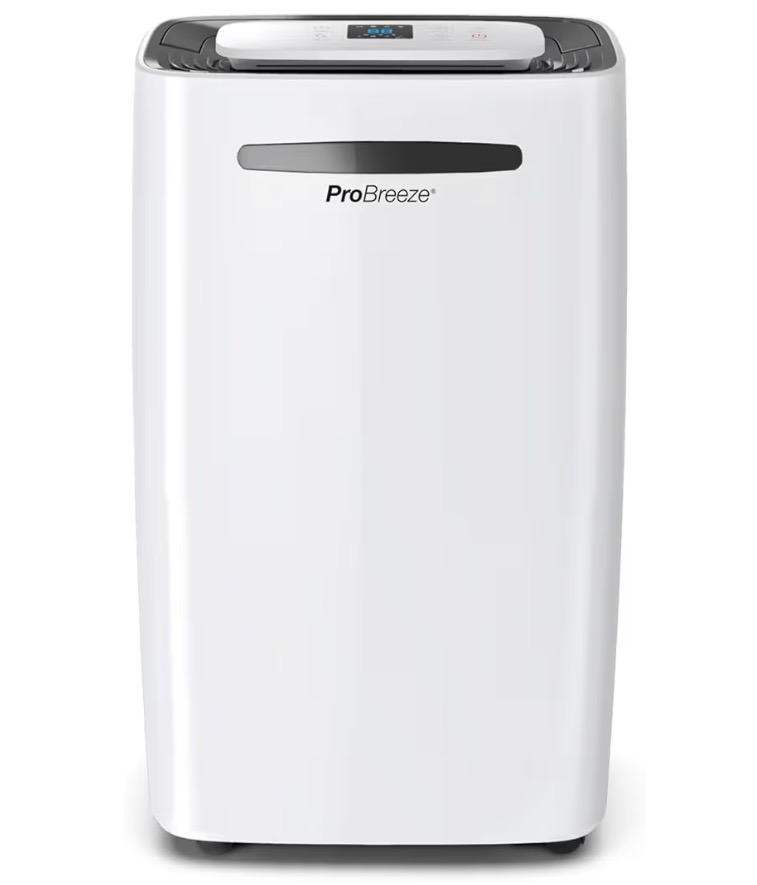
- Pro Breeze 20L Dehumidifier — for larger rooms or continuously high humidity levels. See price on Amazon · our review
- R.W.FLAME Auxiliary Heater — to maintain a stable temperature in rooms at risk of condensation. See price on Amazon · our review
- Digital Hygrometer / Thermometer — essential for objectively measuring the humidity rate before acting. see our comparison
If mold is already established over several square meters or returns every winter in the same place, heating will not be enough: consult our guide on treating mold.
Frequently Asked Questions
Does an electric radiator dry out the air?
No, not in the strict sense. It warms the air, which mechanically lowers the relative humidity (the percentage), but the actual amount of water contained in the air remains the same. This water re-condenses as soon as the air cools upon contact with a cold surface.
What is the best heating for a damp cellar?
No heating alone solves a humidity problem in a cellar. The most effective combination is an auxiliary heater to stabilize the temperature, combined with a dehumidifier sized for the surface area and the real humidity level measured with a hygrometer.
How long should a heated room be ventilated in winter?
5 to 10 minutes a day with a wide draft is generally enough to renew the air without permanently dropping the wall temperature. This is preferable to a window left slightly open continuously.
At what humidity level should I be concerned?
According to the EPA, it is recommended to maintain relative humidity below 60%, with an ideal range of 30 to 50% depending on the rooms and the season.
Why does mold always appear in the same place?
Because that spot is almost always a thermal bridge or a poorly ventilated area: wall corner, window frame, ceiling corner. The surface temperature drops below the dew point there first.
Should an unoccupied room be heated in winter?
Yes, moderately. Leaving a room completely cold while the rest of the home is heated creates a temperature difference conducive to condensation. A light but continuous heating, combined with regular ventilation, is preferable.
Sources: World Health Organization, "WHO guidelines for indoor air quality: dampness and mould" (2009); National Housing Agency (Anah), fact sheet "Aération des logements"; U.S. Environmental Protection Agency (EPA), recommendations on indoor relative humidity.
This article contains affiliate links. As an Amazon Associate, ZeroHumi earns a commission on qualifying purchases, at no extra cost to you.